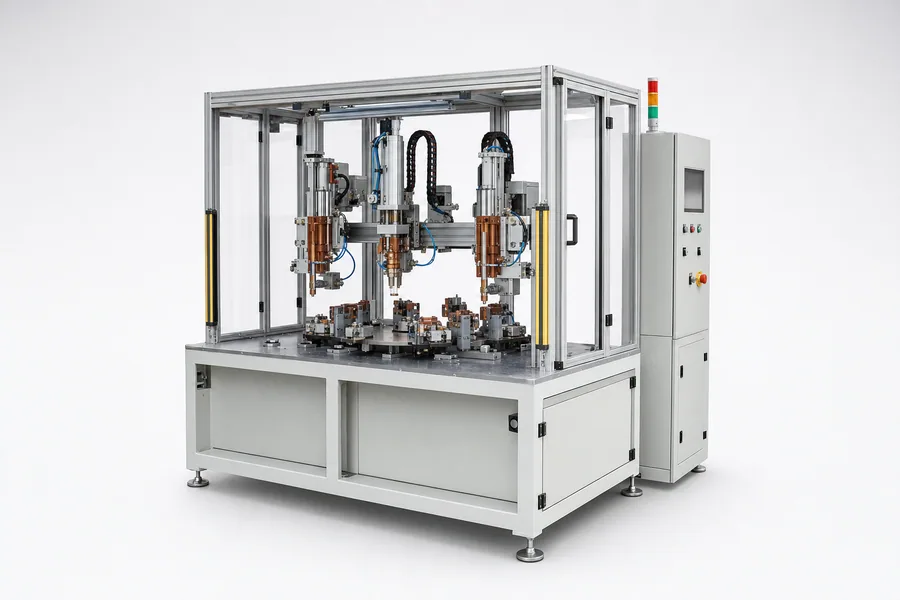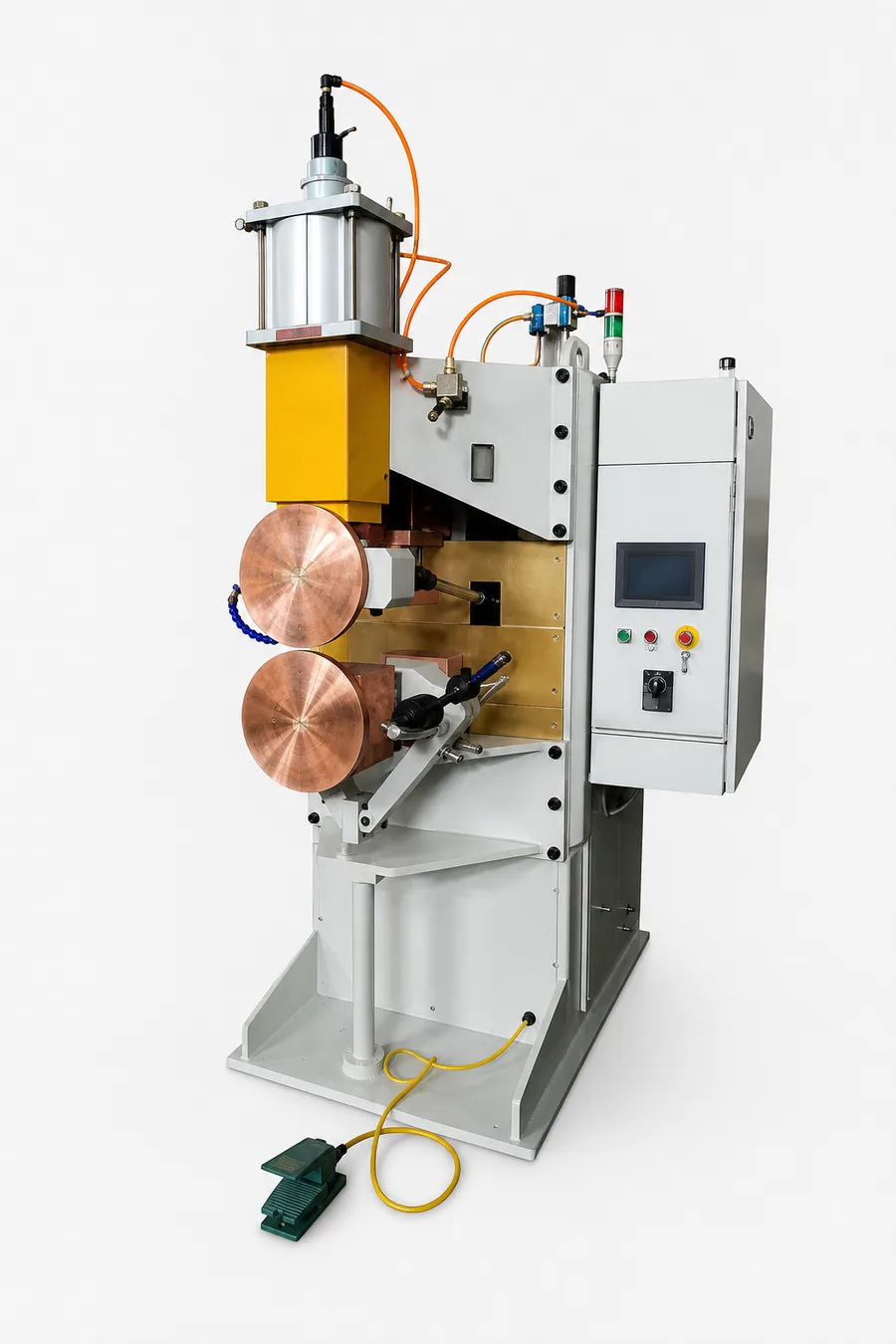
Key takeaways
- Seam geometry and wheel access should be checked before machine capacity.
- Pulse timing and travel speed determine nugget overlap.
- Guiding and fixturing are essential for a consistent seam path.
- Leak-tight or appearance-critical joints need an agreed validation method.
How resistance seam welding works
Wheel electrodes clamp the overlapping sheet edges, carry current and move the joint through the welding zone. The controller can deliver current continuously or in timed pulses. As the part travels, successive nuggets overlap to form the seam.
The required overlap varies with the material, thickness, sealing requirement and travel stability. More heat is not automatically better; excessive energy can cause expulsion, distortion, surface pickup or rapid wheel wear.
Common seam formats
A longitudinal seam follows a straight or guided path along a formed component. A circumferential seam runs around a cylindrical or round part and requires synchronized support and rotation. Application-specific machines may orient the wheels or workpiece to suit the access envelope.
- Lap seams in formed sheet components
- Longitudinal seams on tubes or containers
- Circumferential seams around round assemblies
- Indexed or stitch seams where a continuous seal is not required
Critical process and machine variables
A seam-welding quotation should identify how current, speed and force will be controlled and how the part will remain on the intended path.
| Variable | Primary effect | What to define |
|---|---|---|
| Current and pulse timing | Heat input and nugget formation | Material stack and required overlap |
| Wheel speed | Distance between successive welds | Target cycle and seam quality |
| Electrode force | Contact stability and containment | Sheet stack and joint geometry |
| Wheel profile | Contact area, guidance and marking | Flange width and surface requirement |
| Cooling | Wheel temperature and production stability | Duty cycle and facility water conditions |
Information to send with a seam-welding RFQ
A sample or detailed drawing helps the supplier review wheel access, seam guidance and fixture support before recommending a machine.
- Material grade, coating and sheet thickness
- Part drawing with seam path, overlap and flange dimensions
- Longitudinal or circumferential orientation
- Required sealing, strength and appearance criteria
- Part length or diameter and target travel speed
- Loading, unloading and inspection requirements